Gomio operation demos
Small businesses you can operate from both sides: write as a client, then open the owner’s panel and decide what gets sent. The real estate agency is the main scenario; the accounting firm and the law firm are variations of the same engine. The demos are in Portuguese, built for Brazilian businesses.
Narrated walkthroughs
Who has this problem
A small business owner does not want an AI that talks to clients on its own. They want the repetitive answers handled, and the replies that need judgement brought to them before they go out, so they always know what will be said when the system does not know the answer.
My role
Shared operations engine, policy rules, operator panels and isolated demo deployment.
How to try it
- Open the real estate demo (in Portuguese) and write as a tenant, for example about a rent adjustment.
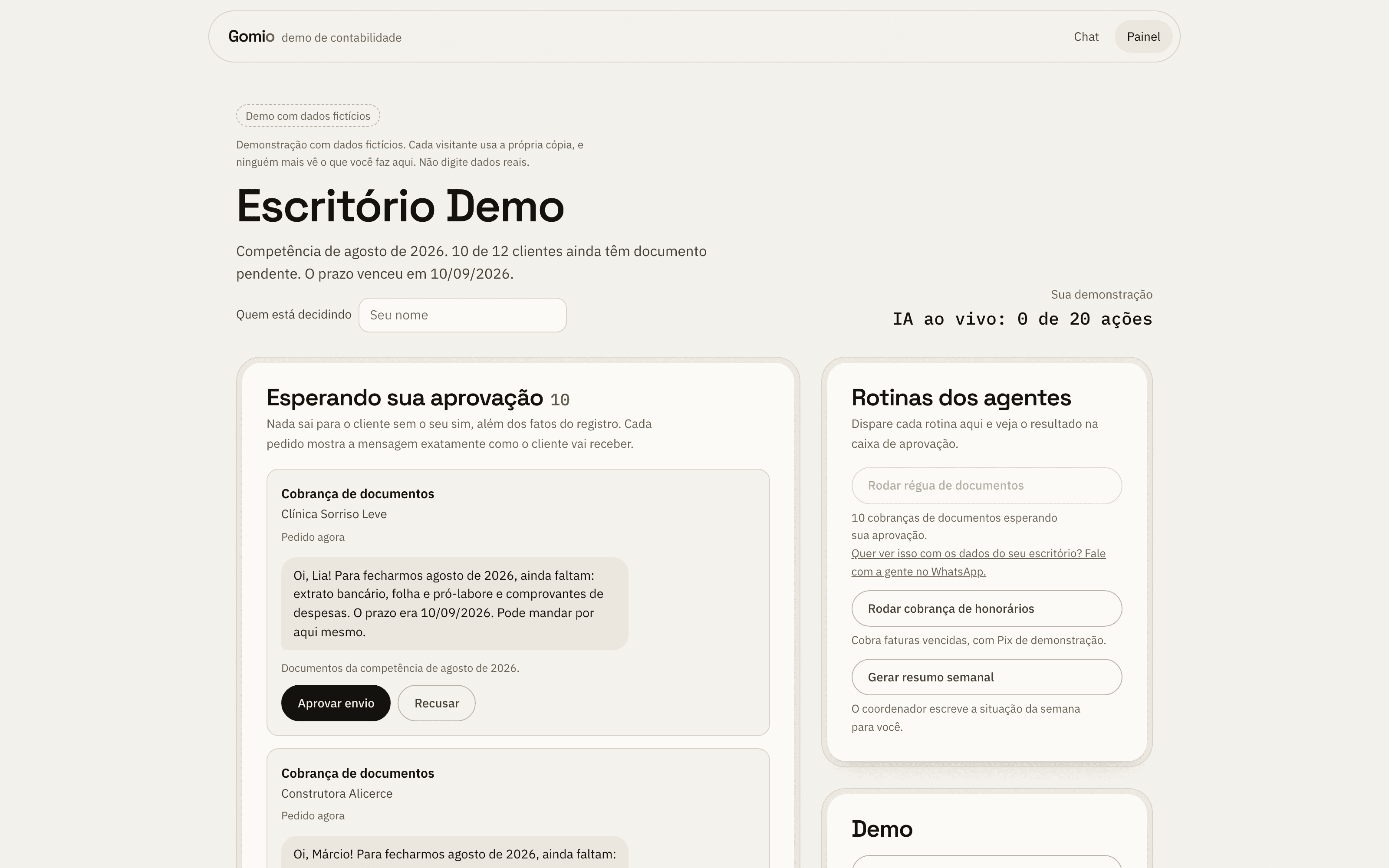
- Open the owner’s panel and approve, edit or discard the reply the system drafted.
- The accounting and law firm demos work the same way, with their own rules.
Usage conditions
- The data is fictional, and each visitor works on a separate copy of it.
- A few new copies per connection per day.
- Each demo has a monthly AI budget of US$ 3.
Public access has usage limits to keep AI service costs under control.
Decisions I made
- Facts come from the records, written by code. When a client asks about a due date, a hearing or a rent adjustment, the answer is built from the business data, not generated by the model.
- Claude Haiku only classifies what the client wants. Claude Sonnet only drafts the replies that need judgement, and those wait in the owner’s panel until a person approves, edits or discards them.
- Each visitor gets a separate copy of the business, so concurrent sessions cannot see each other’s records.
- Each decision and the message that caused it are stored in one transaction, keeping the reply and its decision record together under concurrent writes.
- When a person takes over a conversation, the system stops acting on it. Approving an AI draft for that client is refused until the person hands it back.
- Each niche has its own rules in code: the law firm re-runs the conflict-of-interest check over everything the client wrote when a case is accepted, and the real estate agency answers rent adjustments with official indices from the Central Bank.
- The engine separates facts from model-generated drafts, records each decision with its rule, and stops acting on a conversation when an operator takes over.
Limits that remain
- The data is fictional, and the demos are in Portuguese, built around Brazilian businesses.